Friday, May 29, 2015

Overall Theme of The Diviner's Tale
I believe that Bradford Morrow brings many main ideas together to create a few important themes.
"Divining is finally a form of prayer" (308). Said by Nep.
Some of the most important topics mentioned are:
The entire novel uses ideas that seem to reoccur and haunt Cassandra and no one seems to understand her. The thoughts that the novel has lead me to have been quite interesting. The fact that Laura is a character that was seemingly gone, but then reappears. And the fact that Cassandra faces the man that calls himself Christopher as a pseudonym. It adds a creepy feeling to the story. This leads me to my final thoughts on theme. This is what I feel is the most significant and important theme of Bradford Morrow's The Diviner's Tale:
Every person has different views of the world that no other can fully comprehend and every person experiences different types of creativity and spirituality that are beautiful and appreciated in their own light.
"Divining is finally a form of prayer" (308). Said by Nep.
Some of the most important topics mentioned are:
- Seen vs. Unseen
- Reality vs. Imagination
- Creation
- Nature
- Religion
- Philosophy
- Ancient Greek culture
The entire novel uses ideas that seem to reoccur and haunt Cassandra and no one seems to understand her. The thoughts that the novel has lead me to have been quite interesting. The fact that Laura is a character that was seemingly gone, but then reappears. And the fact that Cassandra faces the man that calls himself Christopher as a pseudonym. It adds a creepy feeling to the story. This leads me to my final thoughts on theme. This is what I feel is the most significant and important theme of Bradford Morrow's The Diviner's Tale:
Every person has different views of the world that no other can fully comprehend and every person experiences different types of creativity and spirituality that are beautiful and appreciated in their own light.
AP?
After reading the majority of The Diviner's Tale, I understand why it is of literary merit.
First of all, the vocabulary in the novel is very rich compared to many of the others that I have read. I remember coming to the realization of this by page 82 where Morrow uses the word "equanimity" to describe a state of mind that Cassandra could not find a Greek word to match. I had to look up that word to discover that it meant "steadiness of mind under stress." This is among many of the other words that I've learned while reading this novel.
Secondly, the complexity of ideas that Morrow writes about in Cassandra's mind is intense and complicated. I must say that this novel is constantly sparking me to think of deep and complex ideas that I've not considered so heavily before. For instance, as a reader, I am constantly reminded of the magic of perception throughout Cassandra's endeavors. Cassandra appears to have a much different reality than the people around her and it makes me question the raness of my own life compared to other people around me.
Thirdly, Morrow intertwines many complex relationships among the characters. For example, Cassandra has Niles who respects her, despite the fact that he doesn't believe her altered perception of the world. She has two twin boys who act very mature for their age and do a great job of emotionally supporting Cassandra. Cassandra's father has always been a huge inspiration to her career as a diviner. She also has a strange relationship with her dead brother Christopher. She claims that she doesn't believe in ghosts, but has a connection with the spiritual world so she can be in touch with her brother. Strangely enough, her perception of reality allows her to hold his memories closer.
Overall, I would say that the complexity of vocab, themes, and relationships make this novel a good choice for AP English students.
First of all, the vocabulary in the novel is very rich compared to many of the others that I have read. I remember coming to the realization of this by page 82 where Morrow uses the word "equanimity" to describe a state of mind that Cassandra could not find a Greek word to match. I had to look up that word to discover that it meant "steadiness of mind under stress." This is among many of the other words that I've learned while reading this novel.
Secondly, the complexity of ideas that Morrow writes about in Cassandra's mind is intense and complicated. I must say that this novel is constantly sparking me to think of deep and complex ideas that I've not considered so heavily before. For instance, as a reader, I am constantly reminded of the magic of perception throughout Cassandra's endeavors. Cassandra appears to have a much different reality than the people around her and it makes me question the raness of my own life compared to other people around me.
Thirdly, Morrow intertwines many complex relationships among the characters. For example, Cassandra has Niles who respects her, despite the fact that he doesn't believe her altered perception of the world. She has two twin boys who act very mature for their age and do a great job of emotionally supporting Cassandra. Cassandra's father has always been a huge inspiration to her career as a diviner. She also has a strange relationship with her dead brother Christopher. She claims that she doesn't believe in ghosts, but has a connection with the spiritual world so she can be in touch with her brother. Strangely enough, her perception of reality allows her to hold his memories closer.
Overall, I would say that the complexity of vocab, themes, and relationships make this novel a good choice for AP English students.
Characters and Relationships: Chapter 10
Characters:
Cassandra and Niles have a long and complicated relationship. They were childhood friends and sweethearts. They eventually got engaged and then split up due to different sexual desires. Although, they went through a tough time, they remain close. Cassandra asked Niles to be the god-father of her twin boys, which he accepted despite the fact that it could upset Melanie. "Niles [risks] hurting his reputation by continuing to associate with his crazy childhood friend, [Cassandra]... Niles, though, didn't treat [her] as crazy. He treated [her] with respect, cutting through the nonsense in the news reports and telling [her] the truth..." (89). It's clear that Niles doesn't necessarily believe all of the "forevisions" (85) that Cassandra goes through, but it is clear that he's a caring friend that is willing to listen to her claims and accommodate for them. They mean a lot to each other.
Cassandra and Nep also have a unique relationship. Being her father, Nep has been the one to step in as Cassandra's main male figure once Christopher died. She looks up to him and see him as an inspiration, even though he admits to being a divining "fraud" (34). After dropping this bomb on Cassandra, he tells her that "[she's] the real deal... sometimes women have powers that men don't... [she has] a gift" (35). This is one of the last meaningful conversations Cassandra and Nep have before Nep's Alzheimer's disease takes over.
It seems that all of Cassandra's positive relationships are with males. She has no female individuals to confide in. I'm curious to see if this plays a role in any future events in the novel.
- Cassandra
- Main character
- 1st person point of view
- Daughter of Nep and Rosalie
- Adult (30s)
- Female
- Single
- Two twin male children
- Diviner and teacher
- Niles
- Childhood friend of Cassandra
- Ex-fiancé if Cassandra
- Married to Melanie
- Father of Adrienne
- Police chief
- God-father of Jonah and Morgan
- Christopher
- Cassandra's brother
- Son of Nep and Rosalie
- Dead
- Nep
- Father of Cassandra and Christopher
- Diviner
- Alzheimer's disease
- Rosalie
- Mother of Cassandra and Christopher
- Not the best relationship with Cassandra
- Very religious (Christian)
- Jonah
- Cassandra's son
- Twin of Morgan
- Morgan
- Cassandra's son
- Twin of Jonah
- Melanie
- Niles' wife
- Mother of Adrienne
- Adrienne
- Daughter of Melanie and Niles
- Laura
- Found in the woods
- Had been abused/raped in a hunter's cabin
- Was discovered thanks to one of Cassandra's divining jobs
- Cassandra feels like she has a connection with her
- Hanged Girl
- Cassandra saw her in the woods while divining
- Had disappeared when she retuned with Niles
- Haunts Cassandra constantly
Cassandra and Niles have a long and complicated relationship. They were childhood friends and sweethearts. They eventually got engaged and then split up due to different sexual desires. Although, they went through a tough time, they remain close. Cassandra asked Niles to be the god-father of her twin boys, which he accepted despite the fact that it could upset Melanie. "Niles [risks] hurting his reputation by continuing to associate with his crazy childhood friend, [Cassandra]... Niles, though, didn't treat [her] as crazy. He treated [her] with respect, cutting through the nonsense in the news reports and telling [her] the truth..." (89). It's clear that Niles doesn't necessarily believe all of the "forevisions" (85) that Cassandra goes through, but it is clear that he's a caring friend that is willing to listen to her claims and accommodate for them. They mean a lot to each other.
Cassandra and Nep also have a unique relationship. Being her father, Nep has been the one to step in as Cassandra's main male figure once Christopher died. She looks up to him and see him as an inspiration, even though he admits to being a divining "fraud" (34). After dropping this bomb on Cassandra, he tells her that "[she's] the real deal... sometimes women have powers that men don't... [she has] a gift" (35). This is one of the last meaningful conversations Cassandra and Nep have before Nep's Alzheimer's disease takes over.
It seems that all of Cassandra's positive relationships are with males. She has no female individuals to confide in. I'm curious to see if this plays a role in any future events in the novel.
Psychological Theme? Chapter 5
The more I read about Cassandra's experiences, the more I am noticing an emerging motif: reality vs. imagination. Niles, a police chief and Cassandra's life-long friend, has been questioning that she saw a dead girl hanging in a tree. Niles upsets Cassandra by asking her if "it's possible [she] sometimes [suffers] from hallucinations... things that should be, even could be, but aren't in any provable way" (28).
Niles asks these questions gently, although it still causes Cassandra to question her divine abilities.
Cassandra describes her state of mind like "drowsing, except you're asleep and intensely awake at the same time" (26). Her divining is mentioned as a state of "euphoria or dysphoria" (26) and a "heightened state of sensitivity" (26). She claims to be "extra-sensitive [and] extra-perceptive" (26) as if she's "communing with some alternate world" (26).
These details make me think really deeply about the power of our minds. How much influence does our mentality have on reality? Do we make up events to fill in voids? How much can we convince ourselves of an idea or event?
Niles asks these questions gently, although it still causes Cassandra to question her divine abilities.
Cassandra describes her state of mind like "drowsing, except you're asleep and intensely awake at the same time" (26). Her divining is mentioned as a state of "euphoria or dysphoria" (26) and a "heightened state of sensitivity" (26). She claims to be "extra-sensitive [and] extra-perceptive" (26) as if she's "communing with some alternate world" (26).
These details make me think really deeply about the power of our minds. How much influence does our mentality have on reality? Do we make up events to fill in voids? How much can we convince ourselves of an idea or event?
Thursday, May 28, 2015
Part I : Divining Cassandra : Chapter 1
The first chapter of The Diviner's Tale introduces the main character, Cassandra. Being in 1st person point of view, we get an inside glimpse of her feelings toward her late brother, Christopher.
"I can still picture him, lanky, loose-jointed, tall as a tree to my eyes, wearing his favorite faded baseball jersey untucked over a pair of worn jeans and scuffed brown boots" (3).
This quote from Cassandra helps demonstrate how much she misses Christopher. She remembers him in such great detail and has no trouble holding on to that loving memory.
"I barricaded my door that night and spent hours memorizing my brother's narrow freckled face, his edgy voice, his gawky mannerisms, his lame jokes, the Christopherness of him, so I could hold him as long as possible in the decaying cradle of memory" (5).
As time goes on after Christopher's death, it becomes apparent that her father has stepped in to fill the void that her brother left. Her mother is not mentioned in a positive light throughout this chapter at all. This makes me feel as though Cassandra really isn't that close with her mother at all.
"...stunned by my mother's disappearance from our lives, and inspired, warmed, and moved by my father, who, however much 'd loved him before, was a revelation to me. The man was possessed, in a quirky way, of genius. I thought so then and still do now, even in the wake of all these intervening years" (6).
This quote from Cassandra's conscience tells me that her father is really the only person in her family that she can relate to. It's clear that she was always closer to her father than her mother, but Christopher's death amplified the relationship. Cassandra sees her father as a true role model.
The book appears to be in past tense. I believe it starts with a flashback to the time of Christopher's death, which must have been during her childhood. After finishing her insights about her family, she says:
"I was feeling okay. My twins were in school" (9).
This tells me that we've jumped ahead in time and she must be old enough to have children. She must have been telling the reader of her childhood from an adult perspective. This perspective helps reveal a more in-depth emotional view of the traumatic event of Christopher's death. The writing style is much more calm and composed than it would be if her brother had truly just died. It seems as though a lot of time has definitely passed.
Morrow also includes a few mythological allusions in Chapter 1:
Cassandra talks about these allusions as references to her favorite subject: mythology. Her acute emotional awareness corresponds with her interest in mythology, in my opinion. Mythology includes a lot of philosophy in things such as religion and morals, which seem to be well developed in Cassandra's narrative. Morrow chose to use a sophisticated array of vocabulary to show Cassandra's stream of consciousness.
Cassandra appears to be deeply moved by things in her environment. I feel as though Morrow chose to describe her feelings in a way that connects to her passion of divining. A diviner must be spiritually connected to his or her environment in order to sense where the water or artifacts are originating from. Cassandra's narrative states:
"Then, without warning or any clear reason my mood should change, a black sensation just poured in, over, and through me" (9).
This gives me the impression that she's sensing something morbid and unpleasant before she really witnesses it. This is similar to how a divine can sense water before seeing it. It's like she has a kind of sixth sense when in the woods.
When Cassandra stumbles upon the dead body of a teenage girl hanging in a tree, see first becomes overwhelmed with depression and then with regret for her death. Although she did not do anything to harm the young girl, she hugs her and tells her that she is sorry and means it with "all [her] heart" (10). This makes me like Cassandra as a character. She seems to have a generally good soul.
Yes, Cassandra seems to be good hearted, but I also get the sense that she may be insane. First, she mentions seeing "a few psychiatrists over the years" (13-14). Then she claims to, "without knowing it" (15) ,"[begin] to divine the girl" (15). Then she returns to the place of the hanging only to find the body missing. She was also "seized by the sickening prospect that someone was nearby taking [her] in" (10). Is she going insane from the trauma of her brother's death?
"I can still picture him, lanky, loose-jointed, tall as a tree to my eyes, wearing his favorite faded baseball jersey untucked over a pair of worn jeans and scuffed brown boots" (3).
This quote from Cassandra helps demonstrate how much she misses Christopher. She remembers him in such great detail and has no trouble holding on to that loving memory.
"I barricaded my door that night and spent hours memorizing my brother's narrow freckled face, his edgy voice, his gawky mannerisms, his lame jokes, the Christopherness of him, so I could hold him as long as possible in the decaying cradle of memory" (5).
As time goes on after Christopher's death, it becomes apparent that her father has stepped in to fill the void that her brother left. Her mother is not mentioned in a positive light throughout this chapter at all. This makes me feel as though Cassandra really isn't that close with her mother at all.
"...stunned by my mother's disappearance from our lives, and inspired, warmed, and moved by my father, who, however much 'd loved him before, was a revelation to me. The man was possessed, in a quirky way, of genius. I thought so then and still do now, even in the wake of all these intervening years" (6).
This quote from Cassandra's conscience tells me that her father is really the only person in her family that she can relate to. It's clear that she was always closer to her father than her mother, but Christopher's death amplified the relationship. Cassandra sees her father as a true role model.
The book appears to be in past tense. I believe it starts with a flashback to the time of Christopher's death, which must have been during her childhood. After finishing her insights about her family, she says:
"I was feeling okay. My twins were in school" (9).
This tells me that we've jumped ahead in time and she must be old enough to have children. She must have been telling the reader of her childhood from an adult perspective. This perspective helps reveal a more in-depth emotional view of the traumatic event of Christopher's death. The writing style is much more calm and composed than it would be if her brother had truly just died. It seems as though a lot of time has definitely passed.
Morrow also includes a few mythological allusions in Chapter 1:
- "I could do worse than wander behind Odysseus for a few months..." (9)
- "...twelve tasks of Hercules..." (9)
- "...story of Pandora's box" (9).
- "...Jason and the Argonauts..." (9)
- "...sword-wielding skeletons..." (9)
- "...ravenous Cyclops..." (9)
- "...and serpent-haired monster Medusa" (9).
Cassandra talks about these allusions as references to her favorite subject: mythology. Her acute emotional awareness corresponds with her interest in mythology, in my opinion. Mythology includes a lot of philosophy in things such as religion and morals, which seem to be well developed in Cassandra's narrative. Morrow chose to use a sophisticated array of vocabulary to show Cassandra's stream of consciousness.
Cassandra appears to be deeply moved by things in her environment. I feel as though Morrow chose to describe her feelings in a way that connects to her passion of divining. A diviner must be spiritually connected to his or her environment in order to sense where the water or artifacts are originating from. Cassandra's narrative states:
"Then, without warning or any clear reason my mood should change, a black sensation just poured in, over, and through me" (9).
This gives me the impression that she's sensing something morbid and unpleasant before she really witnesses it. This is similar to how a divine can sense water before seeing it. It's like she has a kind of sixth sense when in the woods.
When Cassandra stumbles upon the dead body of a teenage girl hanging in a tree, see first becomes overwhelmed with depression and then with regret for her death. Although she did not do anything to harm the young girl, she hugs her and tells her that she is sorry and means it with "all [her] heart" (10). This makes me like Cassandra as a character. She seems to have a generally good soul.
Yes, Cassandra seems to be good hearted, but I also get the sense that she may be insane. First, she mentions seeing "a few psychiatrists over the years" (13-14). Then she claims to, "without knowing it" (15) ,"[begin] to divine the girl" (15). Then she returns to the place of the hanging only to find the body missing. She was also "seized by the sickening prospect that someone was nearby taking [her] in" (10). Is she going insane from the trauma of her brother's death?
What is Divining?
"Divining" is also known as "dowsing". According to the Merriam-Webster Dictionary, the definition of to "dowse" is:
"To search for an underground supply of water by using a special stick that leads you to it."
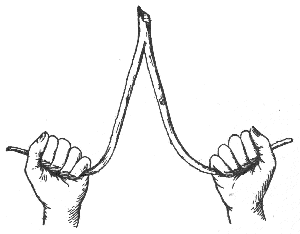
The "special stick" is known as a "divining rod".
This is what a divining rod typically looks like:


dowsers.org is the official website for the American Society of Dowsers. This site contains information about how divining is currently used and where people use it around the world. Anyone is able to register to be a member of the American Society of Dowsers.
To some people, the act of divining is considered a science. Other people see divining as an ancient superstition.
This website has interesting information on divining as an ancient superstition that many people saw as a form of witchcraft.
The USGS website explains the scientific reasoning behind successful dividers.
Divining has typically been associated with the use of water irrigation, but some people believe that they can divine for ancient artifacts and riches in the earth. I'm curious to hear the uses of this craft in The Diviner's Tale.
"To search for an underground supply of water by using a special stick that leads you to it."
The "special stick" is known as a "divining rod".
This is what a divining rod typically looks like:

dowsers.org is the official website for the American Society of Dowsers. This site contains information about how divining is currently used and where people use it around the world. Anyone is able to register to be a member of the American Society of Dowsers.
To some people, the act of divining is considered a science. Other people see divining as an ancient superstition.
This website has interesting information on divining as an ancient superstition that many people saw as a form of witchcraft.
The USGS website explains the scientific reasoning behind successful dividers.
Divining has typically been associated with the use of water irrigation, but some people believe that they can divine for ancient artifacts and riches in the earth. I'm curious to hear the uses of this craft in The Diviner's Tale.
Subscribe to:
Posts (Atom)